The Essential Circular Applique Border Design
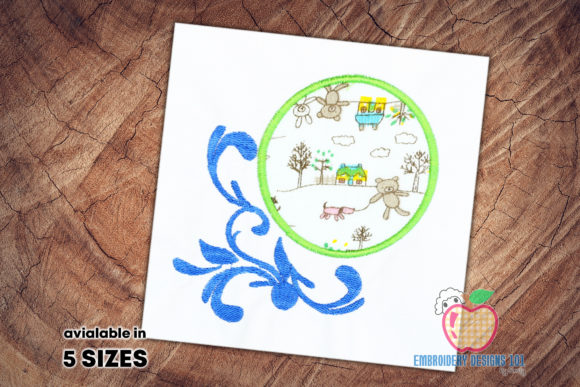
As someone who has spent years designing embroidery patterns for the handmade market, I know that the true test of a design isn't on a screen, but on a product on a craft fair table. When reviewing An Empty Design of Applique in Circle for potential use in my booth this weekend, my first thoughts are purely practical. This is a border design, classified as an embroidery pattern, and that categorization tells me a lot. Its name suggests a minimal, perhaps even a modern rustic or farmhouse aesthetic. It’s not loud or funny; it's decorative and foundational.
The Initial Product Impression
The phrase "empty design" implies space, a negative area that could be filled with fabric texture or background color. This isn't a dense, pictorial piece; it’s a structural outline. On first glance, I would categorize this as a soft, minimal, and decorative element. It feels premium because its value lies in its precise, clean execution. In a crowded marketplace, subtlety can stand out. This design won't shout, but it will whisper quality and attention to detail to the discerning customer who appreciates handmade craftsmanship.
Where This Border Design Earns Its Money
For craft fair sellers and Etsy sellers, every design must be evaluated for its best-fit product. Not every pattern works on every surface. Here’s where I believe An Empty Design of Applique in Circle has its strongest selling potential.
Home Goods & Textiles
This is a natural fit for pillow covers and tea towels. As a border, it can frame the edge of a pillow beautifully, creating a bespoke, finished look that elevates a simple linen cover. On a tea towel, embroidered neatly along the bottom hem, it adds value without overwhelming the fabric's function. The circular shape, repeated or used singly, introduces a gentle geometric rhythm. For apron embroidery, placing this design along the bib border or the waistband can transform a utilitarian apron into a charming, giftable handmade item.
Bags & Accessories
Consider tote bag design. A single, well-placed circle applique border on the front pocket or along the strap attachment points acts as a sophisticated brand signature. For small pouches and market bags, this design serves as a perfect accent—small enough to be cost-effective to produce, but distinctive enough to make the product feel unique. It’s less likely to be a large focal point on a bag, but as a repeated motif or a corner detail, it shines.
The Embroidered Patch Potential
This design is a prime candidate for creating embroidered patches. The circular border naturally contains the design, and the "empty" center is ideal for later customization or simply as a clean, modern patch shape. Patches are incredibly popular and versatile craft fair products. This pattern, rendered as a patch, could be applied to caps, jackets, or sold as a standalone item.
Practical Production & Selling Considerations
Turning a digital embroidery file into a profitable, physical product requires a hard look at the logistics.
Understanding At A Glance
This design should be easy for customers to understand immediately. It’s a shape, a boundary. This clarity helps in photography for your Etsy listings and printable mockups. The product isn't mysterious; it's elegantly simple, which photographs well against clean backgrounds.
Batch Production & Repeatability
For boutique makers doing batch production, a clean, separated-by-color design like this is a friend. The steps being separated by color, as mentioned in the description, suggests efficient production. You can confidently run multiples on tote bags or tea towels knowing each will be consistent. Consistency is key for brand consistency and for building a cohesive booth display.
Sizing: Accent vs. Focal Point
Given its nature, I see this primarily as an accent design. It will likely work best at moderate sizes—not so small that the circular applique detail loses its definition on textured towels or dark fabric, and not so large that it dominates a product meant for a different purpose. Always test the design on scrap fabric first to find its optimal size.
Careful Use Notes for the Professional
Every experienced embroidery designer knows to check the fine details. For An Empty Design of Applique in Circle, pay close attention to the stitch density in the applique outline. Dense stitch areas on curved cap surfaces or thick fabrics like denim can pose challenges. The "empty" center means the design's impact relies entirely on the precision and contrast of its border. Check thread contrast rigorously. A light thread on a dark bag, or a dark thread on a light towel, will make this design pop.
Tiny details might be minimal here, but ensure the design's integrity holds when scaled down for a small pouch. Review spacing within the design itself. Use the right stabilizer for the fabric texture you choose—a kitchen towel requires different support than a smooth cotton pillow cover. Before selling any finished product, create at least one real mockup. See how it looks in person, feels in the hand, and sits on the product.
Final Booth Strategy & Buyer Engagement
In your craft fair booth, products featuring this design should be grouped to tell a story. A display showing a tea towel, a pillow cover, and a tote bag all utilizing the same circular border design demonstrates versatility and strengthens your shop's identity. It shows you offer a coherent aesthetic.
This design affects product value by adding a layer of intentional handmade quality. It’s not a mass-market graphic; it’s a stitched detail. That resonates with buyers looking for something special. Its minimalism also engages buyers who might want customization—the "empty" center naturally invites the question, "Could you add a name inside it?" opening a dialogue for custom orders.
As a final, crucial note: The product description states it comes with multiple embroidery file formats for multiple machines. This is excellent for commercial embroidery. However, always confirm commercial licensing before selling finished products. Confirm the hoop size requirements by testing. Do not assume. These steps protect your small shop and ensure your handmade products are built on a solid, legal foundation.
An Empty Design of Applique in Circle is a quiet asset. In the bustling environment of a handmade market, quiet confidence, displayed on well-crafted goods, often sells best.