Moon Applique Pattern for Craft Fair Products
When I’m reviewing an embroidery design like this Moon Applique Pattern for my upcoming craft fair booth, my first thought is about mood. From the title alone, I know this isn’t a loud, festive design. It leans toward soft, elegant, and modern—maybe with a touch of rustic charm depending on how you execute it. That’s a fantastic starting point for handmade markets, where customers are looking for something decorative but not overwhelming, something that feels premium and giftable.
Where This Moon Design Stands Out on the Sales Table
My booth strategy is to create a cohesive display where designs complement each other without competing. This Moon Applique Pattern, as a backgrounds category design, has a subtle strength. It won’t shout for attention, but on the right product, it will draw customers in with its quiet appeal. I imagine it on a series of linen pillow covers or a set of organic cotton tea towels—products that sell on texture and tone. It would also be stunning as a large focal point on a minimalist tote bag, making the bag feel artistic rather than just utilitarian.
For caps or curved surfaces, I’d be cautious. Applique designs can be tricky on structured hats unless the design is specifically adapted. The moon applique pattern might lose its elegant simplicity if it’s forced onto a cramped, curved space. Its real power, I suspect, is on flat, textured fabrics where the applique technique can really shine and add perceived value.
Practical Production for Batch Selling
As an embroidery business owner, repeatability is key. I need designs I can batch produce without constant tweaks. The product description notes that steps are separated by color changes, which is a huge help for production efficiency. It means I can organize my thread racks and manage my time between hoopings more predictably.
The mention of multiple embroidery file formats is also crucial. It means I, and other makers with different machines, can use this machine embroidery design without conversion headaches, saving precious time before a fair. However, the description doesn’t specify exact hoop size or stitch density. Before I run any production, I’ll test this embroidery file on scrap fabric identical to my final product material. I need to see how it behaves—whether any areas are overly dense for delicate tea towels or if it needs special stabilizer on a slouchy tote bag.
Testing for Quality and Customer Appeal
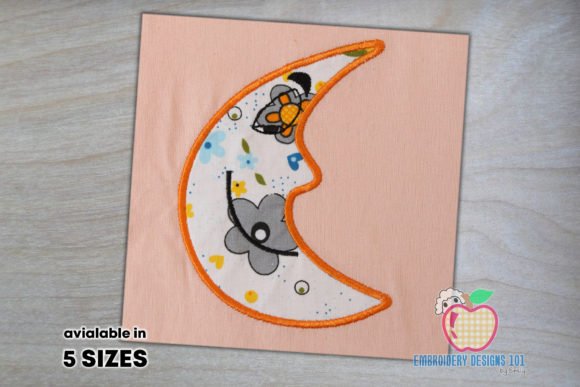
My first step is always a physical mockup. For the Moon Applique Pattern, I’d stitch it out on a mid-weight cotton fabric first. I’m checking for clarity: does the moon shape look crisp? Does the applique lay flat without puckering? This directly impacts handmade quality perception. A slightly puckered design on a tea towel looks homemade in a negative way, while a smooth, flat applique looks professionally crafted.
Then, I’ll test thread contrast. On dark fabric—a popular choice for modern tote bags—I’d likely use a lighter applique material and maybe a metallic silver thread for accent stitches to make the moon pop. On light fabric, a darker or textured applique fabric could add depth. This design seems versatile, but contrast is everything for customer noticeability at a busy fair.
Photographing Products for Online and Booth Samples
A major part of my business is also Etsy seller and online sales. How a design photographs is critical. A moon motif, being a simple, recognizable shape, should photograph well. It’s easy to understand at a glance in an online listing thumbnail. For my booth, having a few beautifully photographed finished products as part of my display—maybe framed prints of the embroidered items—can help customers visualize the design on products they haven’t bought yet.
I would also consider creating printable mockups for my digital listings. Since this is a digital embroidery file, having design assets to create attractive graphics for my Etsy shop or social media is a smart way to market the actual stitched products.
Craft Fair Booth Display Strategy
At the fair itself, I wouldn’t make the moon design the loudest part of my booth. Instead, I’d use it to create a sense of quality and theme. A series of embroidered patches with this moon design, displayed neatly in a frame, could attract the patch collectors. A single, beautifully made market bag with a large moon applique could be my hero product on a display stand, encouraging questions about custom orders.
For small shop product batch production, I’d likely focus on one or two items. Apron embroidery might be a great fit if the apron fabric is sturdy enough for the applique. A set of coordinated kitchen items—a tea towel, a pouch, an apron—with the same moon design can create a high-value bundled gift, increasing the average sale at my booth.
Careful Use Notes for Professional Results
Every design has its quirks. Without knowing the exact stitch count, I’d be mindful of potential dense stitch areas, especially if the moon includes fill details. On textured towels or nubby fabrics, dense stitching can get lost or look messy. I’d test on a sample of that specific fabric first.
Small lettering isn’t mentioned, so I assume this is a purely graphic moon applique pattern. That’s a bonus—no tiny text to lose clarity at smaller sizes. This means I could potentially scale it down for a small accent on a fabric pouch or scale it up for a pillow cover without worrying about readability.
A final, absolutely critical note: the product description doesn’t mention commercial licensing. Before I sell any craft fair product made from this design, I must confirm that I have the right to use this embroidery file for commercial embroidery and sell the finished products. This is a non-negotiable step for any professional embroidery designer or creative entrepreneur.
The Final Verdict for Handmade Market Success
The Moon Applique Pattern strikes me as a strong, versatile contender for the craft fair table. Its elegance and simplicity make it adaptable to a range of products that sell well at markets—tote bags, tea towels, pillow covers, and pouches. Its perceived value is high when executed well on quality fabrics. For production, the separated color steps and multi-format files are practical advantages.
My action plan is clear: test it thoroughly on my chosen fabrics, play with contrast and scale, confirm the commercial license, and then batch produce a coordinated line of items. This design has the potential to be a quiet star in my booth, attracting customers who appreciate subtle, well-made handmade products and boosting my brand’s consistency with a clean, modern aesthetic.